
Amethyst Meaning, Properties, History & How to Wear It
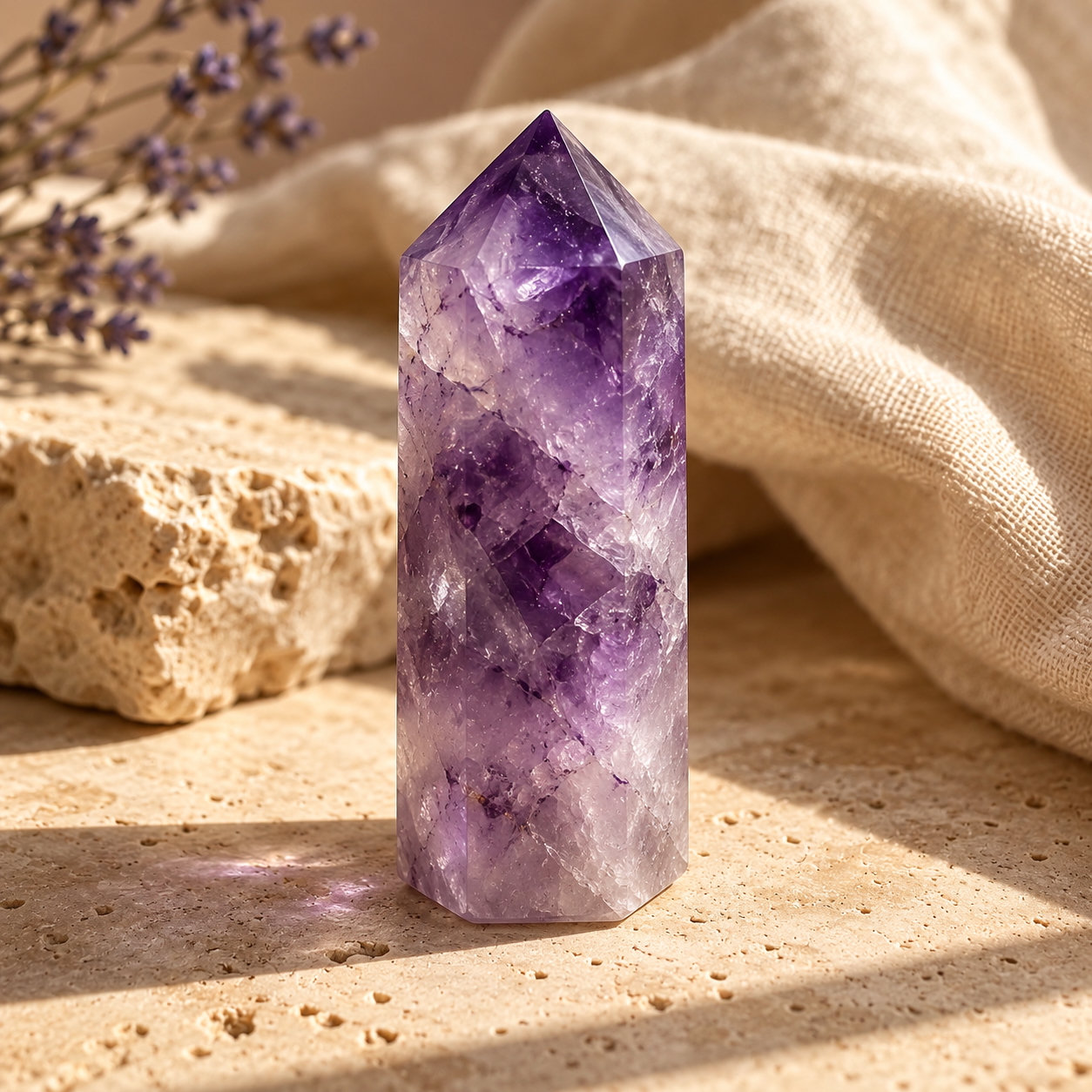
Amethyst is one of the most recognisable members of the quartz family. Its colour can range from the palest lilac to deep violet with blue or reddish undertones, giving each stone its own natural character.
For centuries, Amethyst has been associated with wisdom, sincerity, calm and reflection. It has appeared in jewellery, royal collections, spiritual traditions and decorative objects for generations.
In this guide, we explore what Amethyst is, where its colour comes from, its history and symbolism, traditional chakra associations, how to wear it, which stones pair well with it and how to care for it.
What is Amethyst?
Amethyst is a purple variety of quartz composed primarily of silicon dioxide.
Its violet colour develops from trace amounts of iron within the crystal combined with natural geological processes during formation. Amethyst commonly forms in cavities within volcanic rock, where crystals grow along the inner walls of geodes.
Important sources include Brazil, Uruguay, Madagascar, Russia, Zambia and Australia. Different regions can produce stones with different shades, clarity and crystal formations.
Amethyst Colours & Varieties
Amethyst can appear in a wide range of purple tones.
Some stones are soft and almost pinkish-lilac, while others are rich and intensely violet. A single crystal may also show natural colour zoning, with lighter and darker areas appearing within the same stone.
Some varieties and names you may come across include:
- Chevron Amethyst: characterised by distinctive white and purple banding
- Rose de France: a trade name for very pale lilac Amethyst
- Ametrine: a natural combination of Amethyst and Citrine within the same crystal
- Auralite 23: a commercial name used for certain inclusion-rich Amethyst material
Amethyst colour can fade with prolonged exposure to strong sunlight, so storing it away from intense direct light is a good idea.
Where Does the Name Amethyst Come From?
The name Amethyst comes from the ancient Greek word amethustos, traditionally translated as “not intoxicated” or “not drunk”.
Greek mythology later connected the stone with a story involving Dionysus, the god of wine, and a maiden named Amethyst.
According to the legend, Amethyst was transformed into clear quartz, and Dionysus poured wine over the crystal, turning it violet.
Whether viewed as mythology or symbolism, the story helped shape Amethyst’s long-standing association with moderation, clarity and self-control.
The History of Amethyst
Amethyst was highly valued in both ancient Greece and Rome, where it was used in engraved gems, jewellery and decorative objects.
Over the centuries, it also appeared in royal jewellery and ceremonial pieces across Europe. For a long period, Amethyst was considered one of the most prestigious gemstones alongside stones such as ruby and sapphire.
Its long history has helped establish Amethyst as one of the most symbolically rich quartz varieties.
Amethyst Meaning & Symbolism
Amethyst is traditionally associated with:
- Wisdom
- Sincerity
- Calm
- Reflection
- Clarity
- Self-control
- Inner peace
It has often been viewed as a stone connected with stillness and thoughtful decision-making.
Today, many people choose Amethyst not only for its colour, but also for the personal meaning they attach to it.
These associations come from historical and spiritual traditions rather than scientifically proven effects.
Amethyst and Chakra Symbolism
In modern crystal traditions, Amethyst is most commonly associated with the Crown Chakra, located at the top of the head.
The Crown Chakra is traditionally linked with themes such as:
- Reflection
- Awareness
- Mental clarity
- Spiritual openness
- Perspective
Amethyst is therefore often used symbolically during meditation, quiet reflection or mindfulness practices.
These chakra associations are part of spiritual traditions rather than scientifically established effects.
Is Amethyst a Birthstone?
Yes. Amethyst is widely recognised as the birthstone for February.
It is also sometimes associated with particular zodiac signs in traditional gemstone systems, including Pisces, Sagittarius and Virgo.
Of course, you do not need to be born in February to wear Amethyst. Many people simply choose it because they are drawn to its colour, symbolism or natural beauty.
Traditional Amethyst Associations
In crystal traditions, Amethyst is often described as a stone of calm and reflection.
Some people choose it during moments of meditation, rest or quiet thinking because they associate its violet colour and symbolism with serenity and mental clarity.
Rather than thinking of these qualities as guaranteed effects, they can be viewed as personal symbols or reminders — for example, to slow down, reflect or create a calmer moment in the day.
How to Wear Amethyst
Amethyst is easy to incorporate into everyday jewellery because its purple tones work beautifully with both neutral and bold colours.
Amethyst Bracelets
An Amethyst bracelet is one of the simplest ways to wear the stone every day.
It can be worn on its own for a minimal look or layered with other natural stone bracelets.
Amethyst Necklaces & Pendants
A pendant allows Amethyst to become a more visible focal point.
Many people also enjoy wearing it close to the chest or throat because of the stone’s traditional symbolic associations.
Amethyst Rings
Amethyst rings add a touch of colour without feeling overly dramatic.
With a hardness of around 7 on the Mohs scale, Amethyst is reasonably durable, although it should still be protected from hard knocks and scratches.
Amethyst Earrings
Amethyst earrings are a subtle way to introduce violet tones into an outfit.
They pair particularly well with silver, gold and neutral-toned clothing.
Amethyst at Home
Amethyst is also popular as a decorative stone.
Geodes, clusters and polished points are often displayed in bedrooms, living areas or meditation spaces.
Some people use them simply because they enjoy their natural appearance, while others connect them with traditional ideas of calm and serenity.
Which Stones Pair Well with Amethyst?
Amethyst can be paired with many other natural stones, both visually and symbolically.
Amethyst and Rose Quartz
A soft, gentle pairing often associated with calm, tenderness and emotional warmth.
Amethyst and Clear Quartz
Clear Quartz creates a clean visual contrast and is traditionally associated with clarity and intention.
Amethyst and Labradorite
This combination brings together violet and iridescent tones and is often associated with reflection, intuition and protection.
Amethyst and Selenite
The pale, luminous appearance of Selenite creates a beautiful contrast with deep violet Amethyst.
Amethyst and Fluorite
Both stones are commonly associated in crystal traditions with clarity, focus and reflection.
These pairings are based on colour harmony and traditional symbolism rather than scientifically proven energetic effects.
How to Care for Amethyst
Amethyst is relatively durable, but gentle care will help preserve its colour and shine.
Cleaning
Clean Amethyst using lukewarm water and a soft cloth.
If needed, gently wipe the surface to remove dust or residue.
Avoid:
- Harsh chemicals
- Strong detergents
- Sudden temperature changes
- Prolonged soaking
- Ultrasonic or steam cleaning if the jewellery setting is delicate
Sunlight
Avoid leaving Amethyst in strong direct sunlight for extended periods, as prolonged exposure may cause its purple colour to fade.
Storage
Store Amethyst separately from harder gemstones to help prevent scratches.
A soft pouch or lined jewellery box is ideal.
Amethyst Characteristics at a Glance
- Mineral family: Quartz
- Chemical composition: Silicon dioxide (SiO₂)
- Hardness: 7 on the Mohs scale
- Crystal system: Trigonal / rhombohedral
- Colour: Pale lilac to deep violet
- Major sources: Brazil, Uruguay, Madagascar, Russia, Zambia and Australia
- Traditional symbolism: Wisdom, sincerity and calm
- Birthstone: February
- Chakra association: Crown Chakra
Amethyst FAQs
What colour is Amethyst?
Amethyst ranges from very pale lilac to deep purple.
Natural stones can also show several shades within the same crystal, which makes each piece unique.
Why is Amethyst purple?
Its violet colour is linked to trace amounts of iron and natural geological processes within the quartz crystal.
What does Amethyst traditionally represent?
Amethyst is commonly associated with wisdom, calm, sincerity, reflection and clarity.
These meanings are symbolic and traditional rather than scientifically proven.
Which chakra is Amethyst associated with?
Amethyst is most often linked with the Crown Chakra, traditionally associated with awareness, clarity and spiritual openness.
Can Amethyst go in sunlight?
Short exposure is generally fine, but prolonged strong sunlight can gradually fade its purple colour.
Which stones pair well with Amethyst?
Popular pairings include Rose Quartz, Clear Quartz, Labradorite, Selenite and Fluorite.
Final Thoughts
Amethyst is one of the most timeless natural stones in jewellery.
Its violet colour, long history and traditional symbolism make it appealing for many different reasons — whether you are drawn to its beauty, its connection with reflection and calm, or simply the way it feels personal to you.
From soft lilac to deep purple, every Amethyst has its own character.
Discover our Amethyst jewellery and find the piece that speaks to you.