
Labradorite Meaning, Properties, History & How to Wear It
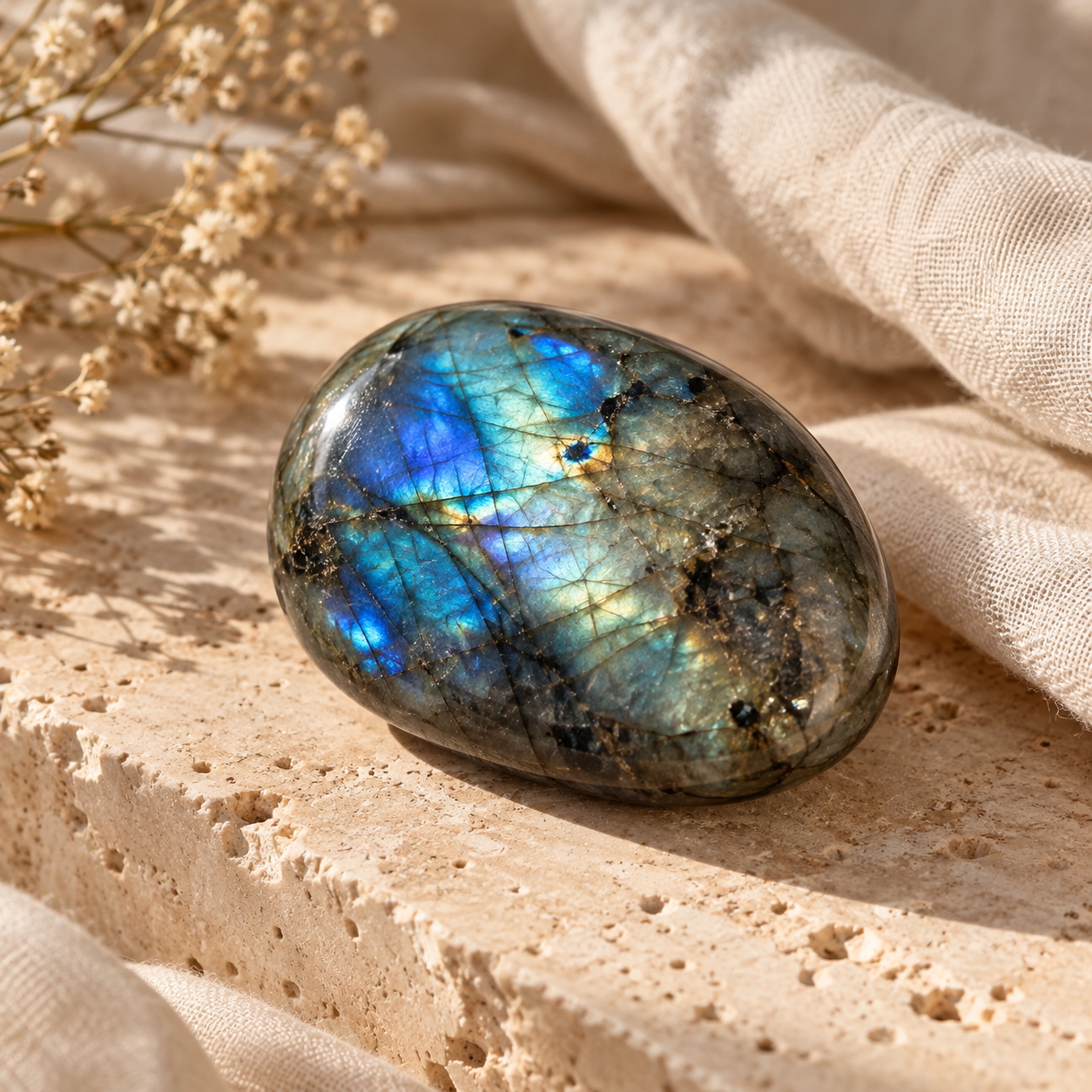
Labradorite is one of the most distinctive natural stones, known for the flashes of blue, green, gold and sometimes violet that appear when light moves across its surface.
At first glance, the stone may seem grey or understated. Turn it slightly, however, and its colour can suddenly come alive. This optical effect is known as labradorescence and is one of the reasons Labradorite has become so popular in natural stone jewellery.
In this guide, we explore what Labradorite is, where its colours come from, its history and traditional symbolism, chakra associations, how to wear it, which stones pair well with it and how to care for it.
What is Labradorite?
Labradorite belongs to the feldspar group of minerals, specifically the plagioclase feldspars.
It is composed primarily of sodium and calcium aluminosilicate and has a hardness of around 6 to 6.5 on the Mohs scale. This makes it suitable for many types of jewellery, although it is still softer than stones such as quartz and should be protected from strong impacts.
Labradorite is commonly polished into cabochons because the smooth, curved surface helps reveal its characteristic flashes of colour.
What is Labradorescence?
The shifting colours seen in Labradorite are caused by an optical phenomenon known as labradorescence.
The effect does not come from coloured pigment. Instead, Labradorite contains extremely thin internal layers. When light enters the stone, it reflects and interferes between these layers, causing certain colours to become more visible depending on the viewing angle.
This can create flashes of:
- Blue
- Aqua
- Green
- Gold
- Violet
- Copper
No two pieces of Labradorite look exactly alike. One stone may show an intense electric blue flash, while another reveals softer greens, golds or several colours at once.
That individuality is part of Labradorite's appeal.
Where Does Labradorite Come From?
Labradorite takes its name from the Labrador region of Canada, where the stone was documented in the 18th century.
It was discovered there in 1770, and its remarkable shifting colours quickly attracted attention.
Today, Labradorite can also be found in several other parts of the world, including Madagascar, Finland and other regions known for feldspar deposits.
The History & Legends of Labradorite
Labradorite has inspired stories almost as striking as the stone itself.
One traditional story from the Labrador region describes the Northern Lights as having once been trapped inside the rocks. According to the legend, a warrior struck the stone and released some of the lights into the sky, while others remained captured within the rock.
The flashes seen in Labradorite were therefore imagined as pieces of the aurora still held inside the stone.
Whether taken as folklore or simply as a beautiful story, the comparison is easy to understand when Labradorite catches the light.
Labradorite Varieties
Labradorite can appear in several different forms.
Classic Labradorite
The most familiar variety typically has a grey to dark grey base with blue, green or golden flashes.
Spectrolite
Spectrolite is a particularly vivid variety of Labradorite associated especially with Finland.
It often has a very dark background and can display an unusually broad spectrum of colours, including blue, green, yellow, orange and reddish tones.
Rainbow Moonstone
Despite its name, Rainbow Moonstone is technically a light-coloured variety of Labradorite.
It usually has a white or translucent base with blue flashes and a softer, pearly appearance.
Colourful Labradorite
Some Labradorite specimens show brighter greens, yellows, orange tones or metallic-looking flashes rather than the classic blue.
The intensity and colour of every stone depend on its internal structure and the angle at which it is viewed.
Labradorite Meaning & Symbolism
In crystal traditions, Labradorite is commonly associated with:
- Protection
- Intuition
- Reflection
- Confidence
- Inner clarity
- Transformation
- Self-awareness
It is sometimes described symbolically as a protective or shielding stone, particularly for people who feel sensitive to the atmosphere around them.
Its changing appearance has also made Labradorite a natural symbol of transformation — a reminder that things may reveal a different side when viewed from another perspective.
These meanings come from spiritual and cultural traditions rather than scientifically established effects.
Labradorite and Chakra Symbolism
In modern crystal traditions, Labradorite is most commonly associated with the Third Eye Chakra and Throat Chakra.
It is sometimes also linked with the Crown Chakra.
Third Eye Chakra
The Third Eye Chakra is traditionally associated with:
- Intuition
- Reflection
- Awareness
- Perspective
- Inner insight
For this reason, Labradorite is often chosen for meditation or moments of personal reflection.
Throat Chakra
The Throat Chakra is traditionally connected with communication and self-expression.
Labradorite jewellery worn near the neck may therefore carry an additional symbolic meaning for people who associate the stone with speaking openly and trusting their own voice.
These chakra associations are traditional rather than scientifically proven.
Traditional Labradorite Associations
Labradorite has become especially popular among people drawn to themes of protection and personal reflection.
Some choose it as a symbolic reminder to:
- Protect their personal space
- Trust their intuition
- Pause before making decisions
- Stay connected to themselves
- Approach change with confidence
Rather than expecting the stone to create these effects, Labradorite can simply serve as a personal object connected with an intention or mindset.
How to Wear Labradorite
One of Labradorite's greatest strengths is how beautifully it changes throughout the day.
Its flashes become especially noticeable as jewellery moves through different angles of light.
Labradorite Bracelets
A Labradorite bracelet allows the stones to catch the light every time you move your wrist.
Because every bead may reflect differently, even a simple bracelet can show several shades of blue, green and grey.
Labradorite Necklaces & Pendants
Larger Labradorite cabochons work beautifully in necklaces and pendants because there is enough surface area to display the stone's flash.
Pendants can range from subtle grey stones with a single blue reflection to dramatic pieces with intense colour.
Labradorite Rings
Labradorite rings can be particularly striking because movement of the hand constantly changes the angle of the stone.
Because Labradorite is softer than quartz, rings should be treated with some care and protected from hard knocks.
Labradorite Earrings
Labradorite earrings are another beautiful option because the movement naturally reveals the stone's shifting colours.
They work especially well with simple outfits where the flashes of blue or green can stand out.
Labradorite at Home
Labradorite does not need to be worn as jewellery.
Polished stones, palm stones and decorative pieces can also be kept on a desk, bedside table or meditation space.
Some people simply enjoy watching the colour change under different lighting, while others use the stone as a symbolic reminder during quiet moments or mindfulness practices.
Which Stones Pair Well with Labradorite?
Labradorite combines beautifully with other natural stones.
Labradorite and Moonstone
Both stones belong to the feldspar family and can display beautiful optical effects.
Visually, they create a soft combination of blue flashes, grey tones and pearly whites.
Within crystal traditions, the pairing is often associated with intuition and reflection.
Labradorite and Amethyst
The purple tones of Amethyst work beautifully with Labradorite's blue and violet flashes.
Both stones are traditionally associated with reflection and calm.
Labradorite and Clear Quartz
Clear Quartz creates a light, neutral contrast with Labradorite.
In crystal traditions, Clear Quartz is often associated with clarity and intention.
Labradorite and Black Tourmaline
The deep black of Tourmaline creates a striking contrast with Labradorite.
Both stones are traditionally connected with protection and grounding.
Labradorite and Obsidian
Obsidian creates another darker pairing, particularly for people who prefer black, grey and blue jewellery.
These combinations are based on colour harmony and traditional symbolism rather than scientifically proven energetic effects.
How to Care for Labradorite
Labradorite has a hardness of approximately 6 to 6.5 on the Mohs scale, so it requires slightly more care than harder gemstones.
Cleaning
Use a soft cloth with a small amount of lukewarm water.
If needed, gently wipe away dust, perfume or cosmetic residue.
Avoid:
- Harsh chemicals
- Strong cleaning products
- Ultrasonic cleaners
- Steam cleaners
- Prolonged soaking
- Strong impacts
Storage
Store Labradorite separately from harder jewellery to reduce the chance of scratching.
A soft pouch or lined jewellery box is ideal.
Everyday Care
Remove Labradorite jewellery before:
- Swimming
- Showering
- Exercising
- Cleaning
- Applying perfume or cosmetics
Avoid prolonged exposure to strong heat and take care not to knock the stone against hard surfaces.
Labradorite Characteristics at a Glance
- Mineral family: Feldspar
- Group: Plagioclase feldspar
- Composition: Sodium and calcium aluminosilicate
- Hardness: Approximately 6–6.5 on the Mohs scale
- Appearance: Grey to dark base with shifting flashes of colour
- Optical effect: Labradorescence
- Notable varieties: Spectrolite and Rainbow Moonstone
- Traditional symbolism: Protection, intuition, reflection and transformation
- Chakra associations: Third Eye and Throat Chakra
Labradorite FAQs
What colour is Labradorite?
Labradorite usually has a grey, dark grey or sometimes nearly black base.
When light hits the stone from certain angles, it can reveal vivid flashes of blue, green, gold, violet or copper.
This effect is known as labradorescence.
Why does Labradorite change colour?
Labradorite does not actually change its pigment.
Light interacts with microscopic internal layers in the stone, creating different colours depending on the angle.
That is why the same Labradorite may look grey in one position and brilliant blue in another.
What is the difference between Labradorite and Spectrolite?
Spectrolite is a particularly colourful variety of Labradorite most closely associated with Finland.
It usually has a darker base and may display a broader and more intense range of colours.
All Spectrolite is Labradorite, but not all Labradorite is Spectrolite.
What does Labradorite traditionally represent?
Labradorite is commonly associated with protection, intuition, confidence, transformation and reflection.
These meanings come from crystal traditions and should be understood symbolically rather than as scientifically proven effects.
Which chakra is Labradorite associated with?
Labradorite is most often connected with the Third Eye Chakra and Throat Chakra, and is sometimes also linked with the Crown Chakra.
Is Labradorite the same as Moonstone?
No.
Labradorite and traditional Moonstone are related feldspar minerals but are not the same stone.
However, Rainbow Moonstone is actually a light-coloured Labradorite variety, despite its common name.
How should I clean Labradorite?
Use a soft cloth and lukewarm water, then dry the stone carefully.
Avoid harsh chemicals, long soaking and strong impacts.
Final Thoughts
Few natural stones change as dramatically with the light as Labradorite.
Its grey surface can suddenly reveal brilliant blue, green and golden flashes, making each piece feel completely individual.
Combined with its long-standing symbolism of protection, intuition and transformation, Labradorite is a stone that can carry many different meanings.
You may choose it because of its traditional symbolism.
You may choose it because no two pieces ever look exactly alike.
Or you may simply see that unmistakable blue flash and feel drawn to it.
Sometimes, that is reason enough.
Discover our Labradorite jewellery and find the piece that speaks to you.