
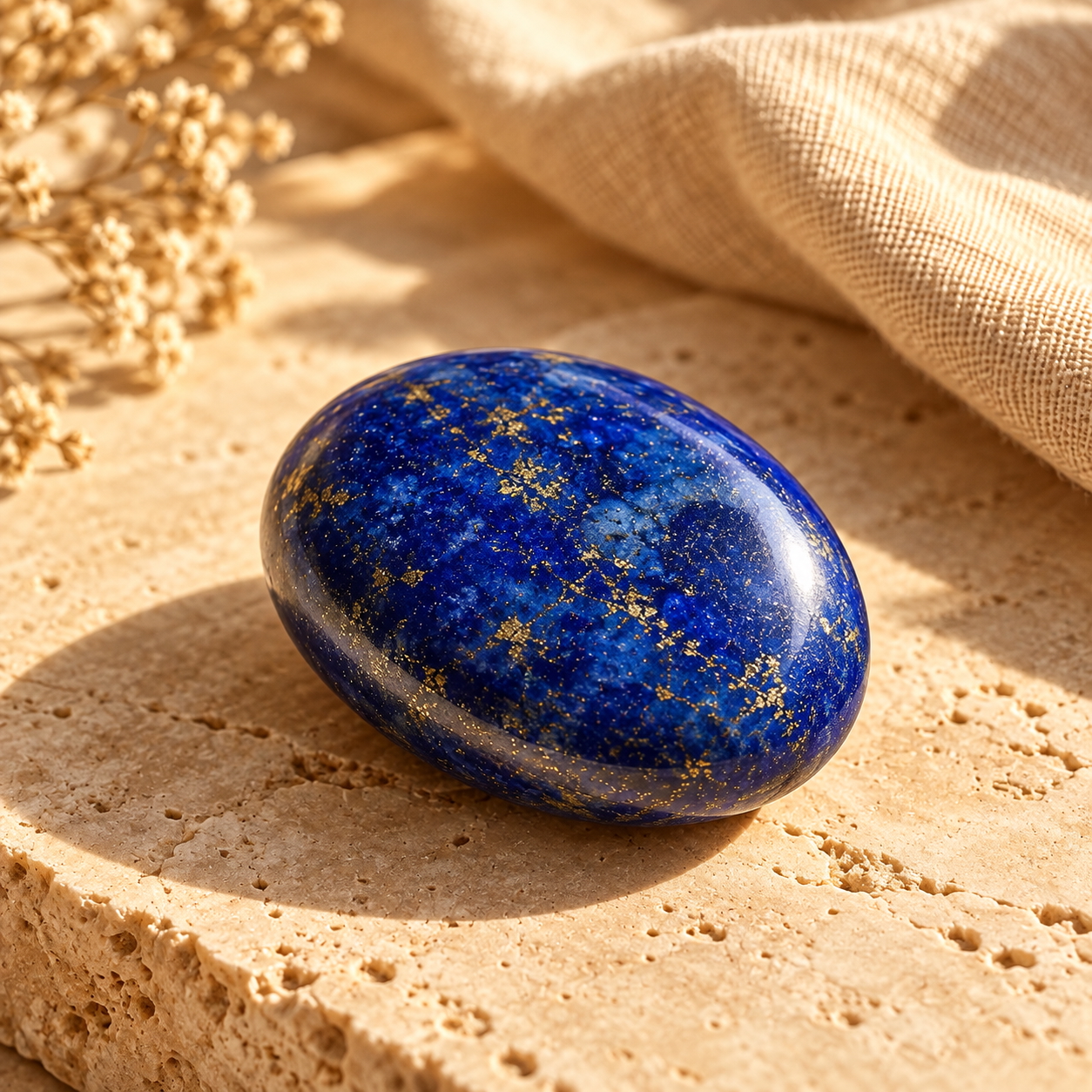
Lapis Lazuli Meaning, Properties, History, Chakra Symbolism & How to Wear It
Lapis Lazuli has captivated people for thousands of years with its deep blue colour, natural golden flecks and unmistakable character. Long associated with wisdom, truth and self-expression, it has appeared in jewellery, art and spiritual traditions across many cultures.
In this guide, we explore the meaning of Lapis Lazuli, its history, traditional symbolism, chakra associations, how to wear it, which stones pair well with it and how to care for it.
What is Lapis Lazuli?
Lapis Lazuli is a metamorphic rock rather than a single mineral. It is composed mainly of lazurite and may also contain calcite, sodalite and pyrite.
Its signature colour ranges from rich royal blue to deep ultramarine, often with pale veining or golden-looking pyrite inclusions. These natural variations are part of what makes every piece of Lapis Lazuli unique.
Key characteristics:
- Colour: Deep blue to ultramarine
- Composition: Mainly lazurite, with calcite, sodalite and pyrite
- Appearance: Opaque, often with natural veining or golden flecks
- Hardness: Approximately 5–5.5 on the Mohs scale
- Notable sources: Afghanistan, Chile, Russia and other regions
Lapis Lazuli Meaning & Symbolism
For centuries, Lapis Lazuli has been associated with themes of wisdom, truth, confidence and self-expression.
Its intense blue colour has often been linked with the night sky, depth and reflection. In many traditions, it became a symbolic stone for people seeking greater clarity, honesty and connection with their inner voice.
Today, many people choose Lapis Lazuli jewellery not only for its colour, but also for the meaning they personally attach to it.
Traditional associations
Lapis Lazuli is commonly associated with:
- Truth and authenticity
- Self-expression
- Wisdom and reflection
- Confidence
- Creativity
- Inner awareness
- Calm and balance
These associations come from historical and spiritual traditions and should be understood as symbolic rather than scientifically proven effects.
The History of Lapis Lazuli
Lapis Lazuli has one of the longest histories of any ornamental stone.
It was highly valued in ancient Egypt, where it was used in jewellery, decorative objects and burial artefacts. It was also ground into pigment and became prized for its intense blue colour.
The stone was used across ancient Mesopotamia and traded across long-distance routes between Asia, the Middle East and Europe.
During the Renaissance, finely ground Lapis Lazuli was used to create ultramarine pigment. Because of its rarity and cost, the pigment was often reserved for important religious paintings and prestigious works of art.
Its long history has helped shape the symbolism that still surrounds Lapis Lazuli today.
Lapis Lazuli and Chakra Symbolism
In modern crystal traditions, Lapis Lazuli is often associated with the Throat Chakra and Third Eye Chakra.
Throat Chakra
The Throat Chakra is commonly linked with communication, honesty and self-expression.
For this reason, Lapis Lazuli is often chosen as a symbolic reminder to speak with clarity, communicate openly and stay connected to personal truth.
Third Eye Chakra
The Third Eye Chakra is traditionally associated with intuition, reflection and awareness.
Within spiritual practices, Lapis Lazuli may be used during meditation or quiet reflection as a symbolic aid for deeper thought and self-awareness.
These chakra associations are part of spiritual and cultural traditions rather than scientifically established effects.
How to Wear Lapis Lazuli
Lapis Lazuli is easy to wear and works beautifully as both a statement stone and an everyday accent.
Because of its deep blue tone, it pairs especially well with neutral colours, soft whites, earthy shades and metallic details.
Lapis Lazuli necklaces and pendants
A necklace or pendant places the stone close to the throat, which is one reason it is often chosen by people who connect Lapis Lazuli with communication and self-expression.
It also makes a striking focal point in both minimal and layered jewellery looks.
Lapis Lazuli bracelets
Bracelets are a simple way to keep the stone close throughout the day.
They work well worn alone or layered with other natural stone bracelets for a more personal combination.
Lapis Lazuli rings
A Lapis Lazuli ring adds strong colour without overwhelming an outfit.
Because the stone is softer than some gemstones, rings should be worn with a little extra care to avoid knocks and scratches.
Lapis Lazuli earrings
Lapis Lazuli earrings add a refined pop of blue and can work particularly well with silver or gold-toned settings.
Which Stones Pair Well with Lapis Lazuli?
Lapis Lazuli can be combined with other natural stones for colour, contrast or symbolic meaning.
Some popular pairings include:
Lapis Lazuli and Clear Quartz
Clear Quartz is often associated with clarity and intention. Together, the combination feels clean, balanced and versatile.
Lapis Lazuli and Amethyst
Amethyst and Lapis Lazuli create a rich blue-purple combination and are both commonly linked with reflection and mindfulness.
Lapis Lazuli and Turquoise
These two blue stones create a natural, calming palette and are often associated with communication and protection in traditional crystal symbolism.
Lapis Lazuli and Citrine
The deep blue of Lapis Lazuli contrasts beautifully with the warm yellow tones of Citrine.
This pairing works especially well for people who prefer a brighter, more expressive combination.
How to Care for Lapis Lazuli
Lapis Lazuli is relatively soft compared with harder gemstones, so gentle care is best.
Cleaning
Use a soft, slightly damp cloth to clean the surface.
Avoid:
- Harsh chemicals
- Strong detergents
- Ultrasonic cleaners
- Steam cleaners
- Prolonged soaking in water
Storage
Store Lapis Lazuli separately from harder stones and jewellery to reduce the risk of scratches.
A soft pouch or lined jewellery box is ideal.
Everyday wear
Remove your Lapis Lazuli jewellery before:
- Showering
- Swimming
- Exercising
- Applying perfume or cosmetics
- Using household cleaning products
This helps preserve the stone and setting over time.
How Can You Tell if Lapis Lazuli is Real?
Natural Lapis Lazuli usually shows variation rather than a perfectly uniform colour.
You may notice:
- Different shades of blue
- Pale calcite veining
- Small pyrite flecks
- Natural irregularities in colour and pattern
These differences are normal and are part of the stone’s individual character.
Because dyed and imitation stones also exist, buying from a trusted jewellery retailer is important if natural stone authenticity matters to you.
Is Lapis Lazuli a Birthstone?
Lapis Lazuli is sometimes associated with December in traditional or alternative birthstone lists, although it is not one of the principal modern birthstones used in every system.
It is also commonly chosen for reasons that have nothing to do with birth months — including colour, symbolism and personal connection.
Can You Sleep with Lapis Lazuli?
Some people choose to keep Lapis Lazuli near their bed as part of meditation, reflection or personal spiritual routines.
There is no scientific evidence that the stone affects sleep, so this is best viewed as a personal or symbolic practice.
If you wear Lapis Lazuli jewellery, removing it before sleep can also help protect both the stone and the jewellery setting.
Does Lapis Lazuli Need to Be Cleansed or Recharged?
In crystal traditions, some people choose to cleanse stones as part of a personal ritual.
Common methods may include:
- Placing the stone in moonlight
- Using smoke from incense or herbs
- Resting it near other crystals
These practices are symbolic and optional.
For physical care, the most important thing is simply to keep Lapis Lazuli clean, dry and protected from harsh chemicals.
Why Choose Lapis Lazuli Jewellery?
Lapis Lazuli stands out because it combines strong natural colour with centuries of cultural history.
Its deep blue tone can feel bold and refined at the same time, while its traditional symbolism gives it an added layer of meaning.
For some, it represents truth. For others, creativity, confidence or reflection.
And sometimes, the reason is simpler: you are drawn to the stone.
That alone can be meaningful.
Final Thoughts
Lapis Lazuli has been admired for thousands of years, and it is easy to see why.
Its rich blue colour, natural variation and long symbolic history make it one of the most distinctive natural stones used in jewellery.
Whether you are drawn to its traditional meaning, its history or simply its appearance, Lapis Lazuli is a beautiful stone to wear and make your own.
Discover our Lapis Lazuli jewellery and find the piece that speaks to you.