
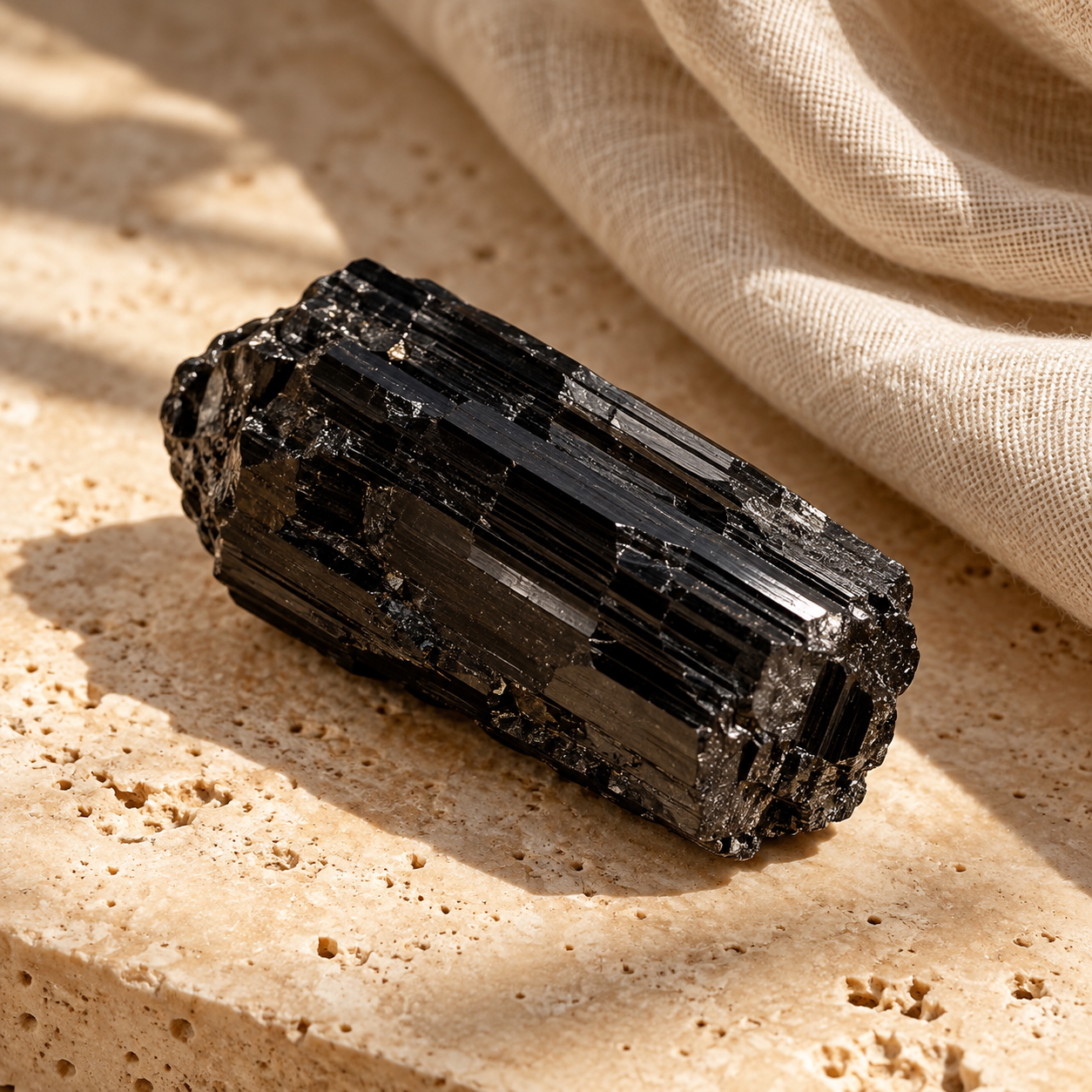
Tourmaline Meaning, Properties, History & How to Wear It
Tourmaline is one of the most varied natural stones in the world. It can appear in deep black, soft pink, vivid green, rich blue, warm brown and even in several colours within a single crystal.
Because of this remarkable range, Tourmaline has collected many different meanings over time. Black Tourmaline is traditionally associated with protection and grounding, while pink, green and blue varieties are often linked with themes such as tenderness, renewal, communication and balance.
In this guide, we explore what Tourmaline is, where its name comes from, its history, traditional symbolism, chakra associations, how to wear it, which stones pair well with it and how to care for it.
What is Tourmaline?
Tourmaline is not a single mineral but a family of boron silicate minerals with a shared crystal structure.
Mineralogists recognise many different Tourmaline species, but jewellery most commonly features a few well-known varieties:
- Schorl: the iron-rich variety commonly known as Black Tourmaline
- Elbaite: responsible for many coloured Tourmalines
- Dravite: typically found in brown to yellow shades
Tourmaline can also be described by colour variety:
- Rubellite: pink to red
- Verdelite: green
- Indicolite: blue
- Watermelon Tourmaline: pink at the centre with green around the edge
Tourmaline usually measures around 7 to 7.5 on the Mohs hardness scale, making it durable enough for many types of everyday jewellery when treated with care.
Important sources include Brazil, Afghanistan, Pakistan, Nigeria, Mozambique, Madagascar, Sri Lanka and the United States.
Where Does the Name Tourmaline Come From?
The name Tourmaline is believed to come from the Sinhalese word turmali or toramalli, once used by Sri Lankan gem traders to describe mixed-colour stones.
The name suits the stone well, because Tourmaline was historically mistaken for other gemstones due to its wide range of colours. Some stones once thought to be rubies or emeralds were later identified as Tourmaline.
The History of Tourmaline
Tourmaline has a fascinating scientific as well as decorative history.
In the 18th century, people noticed that Tourmaline could attract dust and ash when heated or rubbed. This occurs because the stone can become electrically charged, a phenomenon known as pyroelectricity.
Tourmaline later became increasingly popular in jewellery, particularly during the late 19th century. Pink Tourmaline from California was especially admired by the Chinese imperial court, while later discoveries in Brazil introduced striking new colours to the jewellery world.
Today, Tourmaline remains popular for its colour variety, natural character and versatility.
Tourmaline Meaning & Symbolism
Because Tourmaline appears in so many colours, its traditional symbolism often depends on the variety.
Black Tourmaline
Black Tourmaline is traditionally associated with:
- Protection
- Grounding
- Stability
- Feeling centred
- Creating symbolic boundaries
It is one of the most commonly chosen stones for people drawn to themes of protection and grounding.
Pink Tourmaline
Pink Tourmaline is often associated with:
- Tenderness
- Emotional warmth
- Compassion
- Love
- Gentle self-expression
Green Tourmaline
Green Tourmaline is traditionally linked with:
- Renewal
- Growth
- Vitality
- Confidence
- Balance
Blue Tourmaline
Blue Tourmaline is often connected with:
- Communication
- Calm
- Reflection
- Serenity
- Self-expression
Watermelon Tourmaline
With its natural blend of pink and green, Watermelon Tourmaline is commonly associated with emotional balance and harmony.
These meanings come from crystal traditions and symbolic practices rather than scientifically proven effects.
Tourmaline and Chakra Symbolism
In modern crystal traditions, different Tourmaline colours are associated with different chakras.
- Black Tourmaline: Root Chakra
- Pink Tourmaline: Heart Chakra
- Green Tourmaline: Heart Chakra
- Blue Tourmaline: Throat Chakra
Because of this variety, Tourmaline is often used symbolically in meditation, mindfulness and intention-based practices.
These chakra associations are spiritual traditions rather than scientifically established effects.
Is Tourmaline an October Birthstone?
Yes. Tourmaline is commonly recognised as one of the birthstones for October, alongside Opal.
Its wide range of colours makes it especially versatile as a birthstone, allowing people to choose a shade that feels personal to them.
How to Wear Tourmaline
Tourmaline works beautifully in many types of jewellery.
Tourmaline Bracelets
Black Tourmaline bracelets offer a simple and understated look, while multicoloured Tourmaline bracelets highlight the stone’s natural variety.
A bracelet is also an easy way to keep a meaningful stone close throughout the day.
Tourmaline Rings
Tourmaline rings can range from deep and minimal to bright and colourful.
Because the stone is relatively durable, it can work well in rings, although care should still be taken to avoid hard knocks.
Tourmaline Necklaces and Malas
Tourmaline necklaces allow the stone to become a focal point and can be combined with other natural stones for contrast or symbolic meaning.
Multicoloured Tourmaline also works beautifully in mala-inspired pieces.
Which Stones Pair Well with Tourmaline?
Tourmaline can be paired with many other stones depending on colour and symbolism.
Black Tourmaline and Obsidian
Both are traditionally associated with protection and grounding, making them a popular symbolic pairing.
Black Tourmaline and Tiger’s Eye
This combination pairs the deep black of Tourmaline with the golden-brown tones of Tiger’s Eye.
In traditional crystal symbolism, Tourmaline is often linked with protection while Tiger’s Eye is associated with confidence and focus.
Pink Tourmaline and Rose Quartz
A soft pairing often associated with tenderness, love and emotional warmth.
Tourmaline and Clear Quartz
Clear Quartz creates a clean visual contrast and is traditionally associated with clarity and intention.
These pairings are based on colour harmony and traditional symbolism rather than scientifically proven energetic effects.
How to Care for Tourmaline
Tourmaline is fairly durable, but gentle care will help keep it looking its best.
Cleaning
Use lukewarm water, a small amount of mild soap and a soft cloth or soft brush.
Avoid:
- Harsh chemicals
- Strong detergents
- Sudden temperature changes
- Heavy knocks or impact
Storage
Store Tourmaline separately from harder gemstones to help prevent scratches.
A soft pouch or lined jewellery box is ideal.
Everyday Care
Remove Tourmaline jewellery before:
- Swimming
- Showering
- Exercising
- Applying perfume or cosmetics
- Using household cleaning products
Tourmaline can also attract fine dust when electrically charged through heat or friction, so an occasional gentle wipe with a soft cloth can help restore its shine.
Tourmaline Characteristics at a Glance
- Mineral family: Boron silicates
- Common varieties: Schorl, Elbaite, Dravite
- Hardness: Approximately 7–7.5 on the Mohs scale
- Crystal system: Trigonal
- Colours: Black, pink, red, green, blue, brown, yellow, colourless and multicoloured
- Major sources: Brazil, Afghanistan, Pakistan, Nigeria, Mozambique, Madagascar, Sri Lanka and the United States
- Traditional symbolism: Protection, love, renewal, communication and balance
- Birthstone: October
- Chakra associations: Vary by colour
Tourmaline FAQs
What colour is Tourmaline?
Tourmaline appears in an unusually wide range of colours, including black, pink, red, green, blue, brown, yellow and colourless varieties.
Some crystals also contain several colours at once.
What is the difference between Tourmaline and Black Tourmaline?
Black Tourmaline is one specific variety within the larger Tourmaline family.
The black variety is commonly known as Schorl and contains more iron, while many coloured Tourmalines belong to the Elbaite group.
What does Tourmaline traditionally represent?
The meaning depends on the colour.
Black Tourmaline is commonly associated with protection and grounding, pink with tenderness and love, green with renewal and vitality, and blue with communication and calm.
These meanings are traditional and symbolic rather than scientifically proven.
Why can Tourmaline attract dust?
Tourmaline can develop an electrical charge when heated or rubbed. This physical property is known as pyroelectricity and can cause fine particles such as dust to be attracted to the stone.
Is Tourmaline suitable for everyday jewellery?
With a hardness of around 7–7.5 on the Mohs scale, Tourmaline is suitable for many types of jewellery.
As with all natural stones, it should still be protected from sharp impacts and harsh chemicals.
Final Thoughts
Tourmaline is one of the most diverse natural stones you can wear.
From the deep simplicity of Black Tourmaline to the softness of pink, the freshness of green and the unique contrast of Watermelon Tourmaline, each variety has its own character.
Its long history, remarkable colour range and traditional symbolism make Tourmaline a meaningful choice for jewellery — whether you are drawn to it for its appearance, its story or the personal meaning you give it.
Discover our Tourmaline jewellery and find the colour that speaks to you.